
The Best Thermometer Type for Babies: Forehead, Rectal, or Ear?
When your baby’s forehead feels warm at 2 AM, the last thing you want is a thermometer that takes five tries or gives you three different readings.
You fumble for the thermometer in the dark, but she’s squirming and crying, and you’re getting a different reading every time you try. 99.8°F.
Then 100.6°F.
Wait, now 98.9°F.
Which one is real?
Do you call the pediatrician?
Give medicine?
The thermometer should give you peace of mind, but instead you’re more stressed than when you started.
All three of our kids have put us through countless middle-of-the-night fever checks, and we’ve learned the hard way that not all baby thermometers are created equal.
Here’s what you need to know about choosing a thermometer that’s fast, accurate, and won’t make you second-guess every number.
Not all thermometers are the same
Baby thermometers aren’t just smaller versions of adult thermometers.
The baby’s age plays a huge role in taking temperature
Age ranges matter more than most parents realize.
- A newborn under three months with a fever (rectal temperature) above 100.4°F is a medical emergency requiring immediate attention, which means you need absolute accuracy during those early weeks.
- A three-year-old with the same temperature might just need monitoring and fluids.
The stakes change, and so do your accuracy needs.
Movement and cooperation levels vary wildly too
A newborn will lie relatively still while you take their temperature.
A ten-month-old will twist away from anything you bring near their face.
A two-year-old might cooperate if you’re lucky, or might treat thermometer time as a game of keep-away.
The best thermometer is the one that actually works with your child’s developmental stage.
Where you can safely and accurately measure also changes with age
Rectal temperatures are the gold standard for newborns but become increasingly difficult (and less necessary) as babies get older.
Forehead and ear methods work well for older babies and toddlers but can be unreliable or impossible with tiny newborns.

What does “accuracy” mean – read this!
Most thermometers advertise ±0.4°F accuracy, and that might sound like splitting hairs until you realize how much it matters at the fever threshold.
Pediatricians use 100.4°F as the cutoff for fever in infants, and that’s also the temperature at which you’d typically consider fever-reducing medication or a call to the doctor.
If your thermometer reads 100.2°F but could be off by 0.4°F in either direction, your baby’s actual temperature might be anywhere from 99.8°F to 100.6°F.
One of those scenarios means watchful waiting; the other might mean a trip to urgent care.
Here’s what matters even more than single-reading accuracy: consistency
If you’re tracking a fever over several hours or days, you need to know if it’s going up, going down, or holding steady.
A thermometer that gives you 100.1°F, then 99.3°F, then 100.5°F within five minutes (when nothing has changed) is worse than a thermometer that’s consistently 0.3°F high.
You can work with a consistent offset. You can’t work with random variation.
This is especially important when deciding whether to give fever-reducing medication.
If your thermometer jumps around by a full degree, you’re making medication decisions based on unreliable data.
TLDR; you don’t need laboratory precision, but you do need reliability at the temperatures that matter for medical decisions.
So your baby has a fever and now you’re wondering what’s normal and what’s not. Here are a few things that can help at home, and when you should get medical advice.
The Top 5 Thermometer Types For Babies
1. Temporal Artery (Forehead Scan)
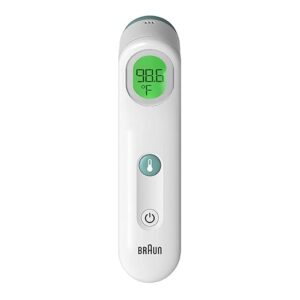
Temporal artery thermometers read infrared heat from the blood flow just under the skin.
You place the sensor flat on the centre of the forehead and slowly swipe toward the hairline (and sometimes behind the ear, depending on the model).
Best for
- Quick checks on wriggly babies
- Households with multiple kids
- Travel or everyday use without disposable tips
Pros
- Very fast: results in 3–5 seconds
- Non-invasive: gentle enough for sleeping babies
- All ages: works from newborns to adults
- Low maintenance: no probe covers to replace
Cons
- Technique matters: speed, pressure, and contact affect accuracy
- Environmental sensitivity: sweat, cold rooms, or just coming indoors can skew readings
- Learning curve: takes a few days to get consistent results
Choose this if
- You’re okay practising the swipe technique
- You need fast readings before kids lose patience
- You want a single thermometer for the whole family
Our go-to is the Braun forehead scanner.
Price Range: $35-50 for quality models
2. Digital Rectal Thermometer (Infants Under 3 Months)
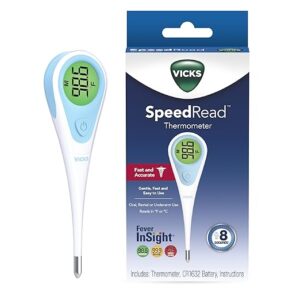
A basic digital thermometer used rectally to measure core body temperature. It’s simple, not fancy, and still the gold standard for newborns.
Best for
- Newborns and infants under 3 months
- Situations where medical accuracy matters
- Readings needed for paediatrician or ER decisions
Pros
- Most accurate method for infants
- Paediatrician-approved: the only reading doctors fully trust at this age
- Affordable: usually $10–15
- Simple to use: no learning curve beyond basic insertion
- Consistent results: very little variation between readings
Cons
- Invasive: baby may cry, mostly from being held still
- Hygiene-sensitive: needs a dedicated, clearly labelled thermometer
- Slower: takes 30–60 seconds per reading
- Not convenient for frequent or quick checks
Choose this if
- Your baby is under 3 months and you suspect a fever
- Your pediatrician asks for a rectal temperature
- Other methods are giving inconsistent results
- You need a number you can trust for a medical decision
Typical price: $10–15
3. Infrared No-Contact Thermometer (Forehead)
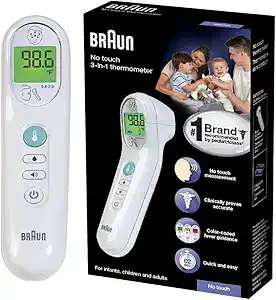
Infrared no-contact thermometers measure forehead temperature from about 1–2 inches away.
You point, press a button, and get a reading without touching your baby.
Best for
- Midnight checks on sleeping babies
- Germ-conscious households
- Quick screening when multiple kids are sick
Pros
- Extremely fast: 1-second readings
- Zero contact: most non-invasive option
- Great for sleep: no need to wake baby
- Easy for anyone to use: no technique to learn
- Bonus features: many models check bottle or bath temperature
Cons
- Less accurate: usually ±0.5–0.7°F
- User error is common: distance and angle matter
- Harder to verify placement: no physical contact cue
- Faster battery drain compared to basic digital thermometers
Choose this if
- You value speed and convenience over precision
- You’ll use it mainly for screening, not decisions
- You plan to confirm high readings with another method
Price Range: $20-40
4. Tympanic (Ear) Thermometer
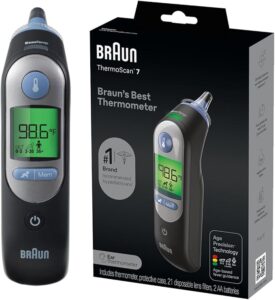
Tympanic thermometers measure temperature at the eardrum using an infrared sensor.
You gently insert a covered probe into the ear canal and get a reading in 1–2 seconds.
Best for
- Babies 6 months and older
- Parents who want speed + accuracy
- Quick checks without dealing with forehead swipes
Pros
- Very fast: 1–2 second readings
- Accurate when positioned correctly: eardrum reflects core temperature
- Doctor-office familiar: commonly used by paediatricians
- Works on sleeping babies if inserted gently
Cons
- Not for newborns: ear canals too small under 6 months
- Technique matters: incorrect positioning affects accuracy
- Ongoing cost: requires disposable probe covers
- More expensive: quality models cost $40–70
Choose this if
- Your baby is 6+ months old with normal-sized ear canals
- You want a balance of speed and medical-grade accuracy
- You’re okay with buying probe covers (about $10 per 40)
- You prefer a method commonly used by doctors
Amazon seller insight:
Ear thermometers get a lot of “doesn’t work” reviews, but most issues come from using them on babies who are too young or incorrect positioning.
When used at the right age and correctly, satisfaction is actually very high.
Typical price: $40–70, plus ongoing probe cover costs
5. Smart Connected Thermometers
Smart thermometers connect to your phone via Bluetooth and log readings in an app.
Some are wearable patches for continuous monitoring, while others are ear or forehead thermometers that sync each reading for tracking over time.
Best for
- Managing illnesses that last several days
- Tracking fever trends and medication timing
- Families with multiple kids and separate profiles
- Parents who want data to share with their paediatrician
Pros
- Trend tracking: see fever patterns over hours or days
- Medication logs & reminders: reduces dosing guesswork
- Helpful for doctor calls: real data beats memory
- Multiple profiles: one device for the whole family
Cons
- Expensive: typically $60–120
- Phone-dependent: needs battery, Bluetooth, and app syncing
- Extra friction: slower for quick checks
- Wearables may irritate skin or fall off active kids
- Overkill for routine use
Choose this if
- You’re managing a multi-day illness
- You want fever, medication, and symptom tracking in one place
- You have multiple kids and want organized records
- You like sharing clear data
Typical price: $60–120
The bottomline
Your pediatrician trusts whatever method you use if you use it correctly.
Choose a thermometer you’re comfortable with, learn the proper technique, use it consistently, and pay attention to trends rather than obsessing over individual readings.
The thermometer is a tool, not a diagnostic device.
It gives you information to combine with everything else you’re observing about your child.
