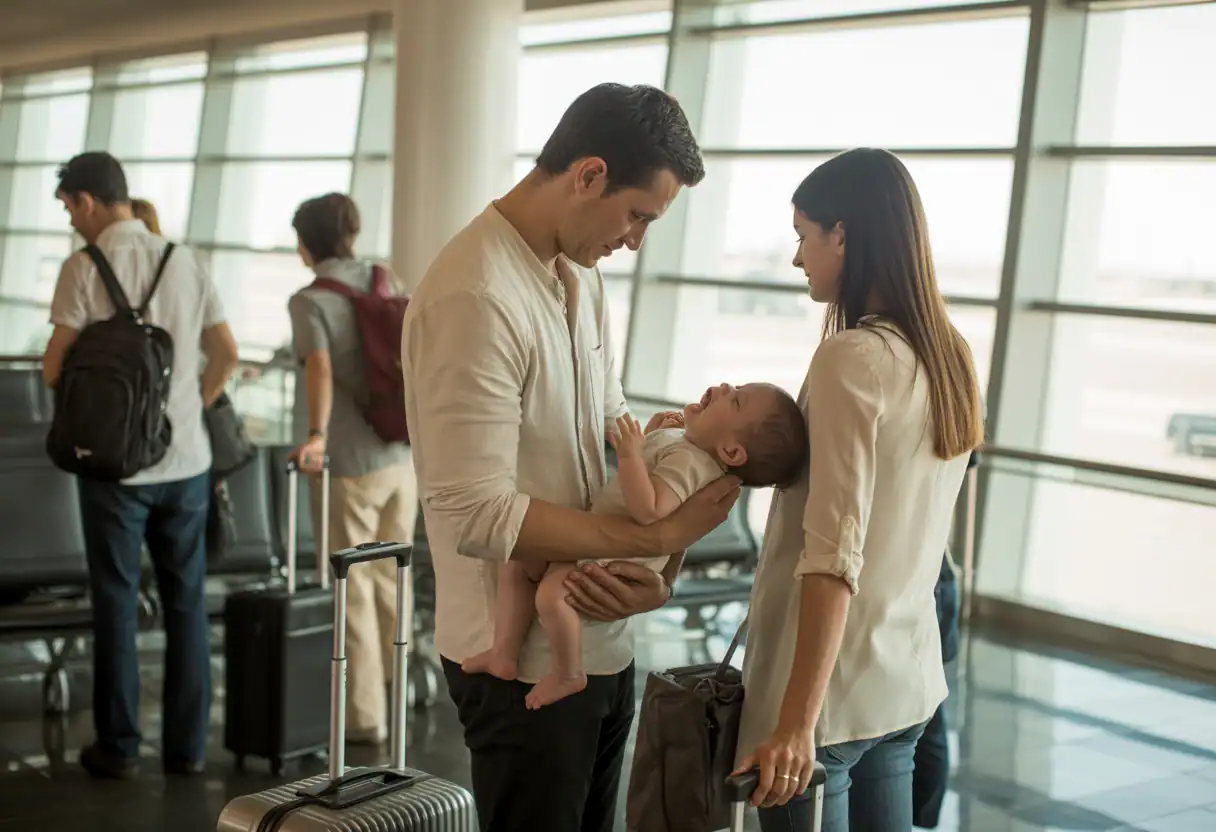
Travelling With a Baby: First-Time Parent Tips and What to Expect
You’ve probably seen those viral “apology bags” parents hand out on flights… as if a baby crying needs a disclaimer. And if you’re flying with your little one for the first time, it’s normal to wonder:
How do you actually travel with a baby?
Do you need to prepare for every worst-case scenario?
What if something goes wrong and you don’t know what to do?
Take a breath.
One reassuring truth before we dive in: Your baby will probably do better than you think.
Here are the tips we wish we knew when we were first-time parents (now parents of three— and yes, we’ve flown with all three at the same time)
You’re more prepared than you realize.
Let’s do a reality check first: Travelling with a baby will always be challenging
- Your baby will cry at some point.
On the plane, in the airport, maybe at the hotel. That doesn’t make you a bad parent. It just makes your baby… a baby.
- You WILL forget things
We’ve left behind pacifiers, loveys, spare clothes, even diapers. As long as you pack the true essentials, everything else can be bought or improvised. There’s always a Target.
- Your trip will look different than pre-baby travel
You won’t be museum-hopping or lingering over long dinners, but you’ll experience a slower, softer version of travel that’s actually pretty sweet when you embrace it.
Let some routines slide. It’s temporary. If naps happen in the stroller instead of the crib, that’s fine. Flexibility is your friend.
The goal isn’t Instagram-perfect. Loosen up, and you might actually have fun.
When should you actually travel with your baby?
Babies are easiest at 2–6 months—they sleep often, aren’t mobile, and are generally calm and portable.
The toughest stage is 8–14 months, when mobility, boredom, and separation anxiety peak.
BUT, every baby is different. The “perfect” time is whenever you’re ready to go.
The best flight time to choose when travelling with a baby
Every “perfect” flight time has trade-offs:
Morning flights mean a well-rested baby.. but a brutal 4 AM start.
Nap-time flights can be dreamy if baby sleeps on takeoff… or a total flop if they skip their nap.
Red-eyes work beautifully for babies who sleep in motion, but if they don’t, you’re stuck in the dark with an overtired infant.

What to pack when travelling with a baby
First-time parents try to plan for every scenario. You can’t.
Focus on four things: Feeding, Sleeping, Diapering, Comfort. Everything else can be bought or improvised.
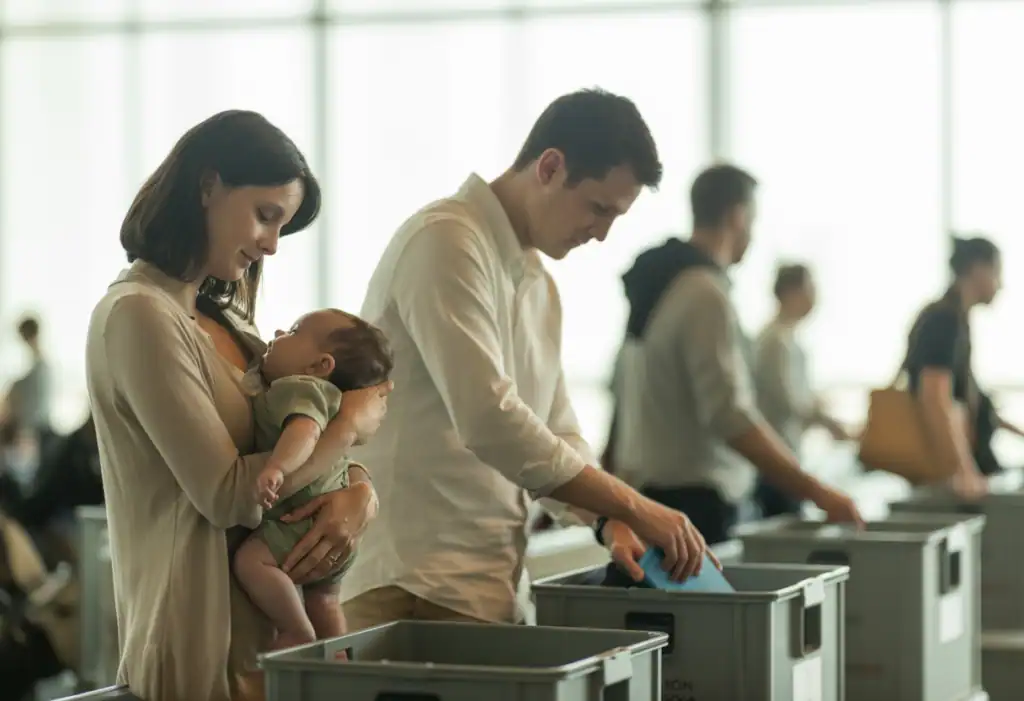
When at the airport…
The ins and outs of navigating the airport with a baby can feel intimidating, but it’s actually simple once you know the flow.
What you need to know:
- Formula, breast milk, and baby food are allowed in full sizes
- Strollers and car seats go through X-ray or get hand-checked
- You’ll carry baby through the metal detector
Best tips:
- Arrive 30–45 minutes earlier than usual
- Ask for the family lane
- Organize before joining the line
- Don’t stress if baby cries—TSA sees it constantly
Can you place your stroller on the overhead bin?
Yes, if you have a small, fold-compact travel stroller that meets carry-on size limits.
These are specifically designed to fit in overhead bins, and brands usually advertise this feature clearly.
Most full-size strollers won’t fit and will need to be gate-checked instead.
Examples are ultra-compact travel strollers like:
- Babyzen Yoyo
- Bugaboo Butterfly
- Joolz Aer
- Nuna TRVL
- GB Pockit+
Even then, it depends on the airline’s carry-on rules and overhead bin space.
Here are some of our top picks for travel-friendly strollers!
Gate-checking vs baggage-checking gear (strollers, car seats etc)
Gate checking means you use your stroller through the airport and hand it over right before boarding. You get it back at the jet bridge after landing.
Baggage checking means you drop it at check-in and retrieve it at baggage claim.
Gate check is usually more convenient.
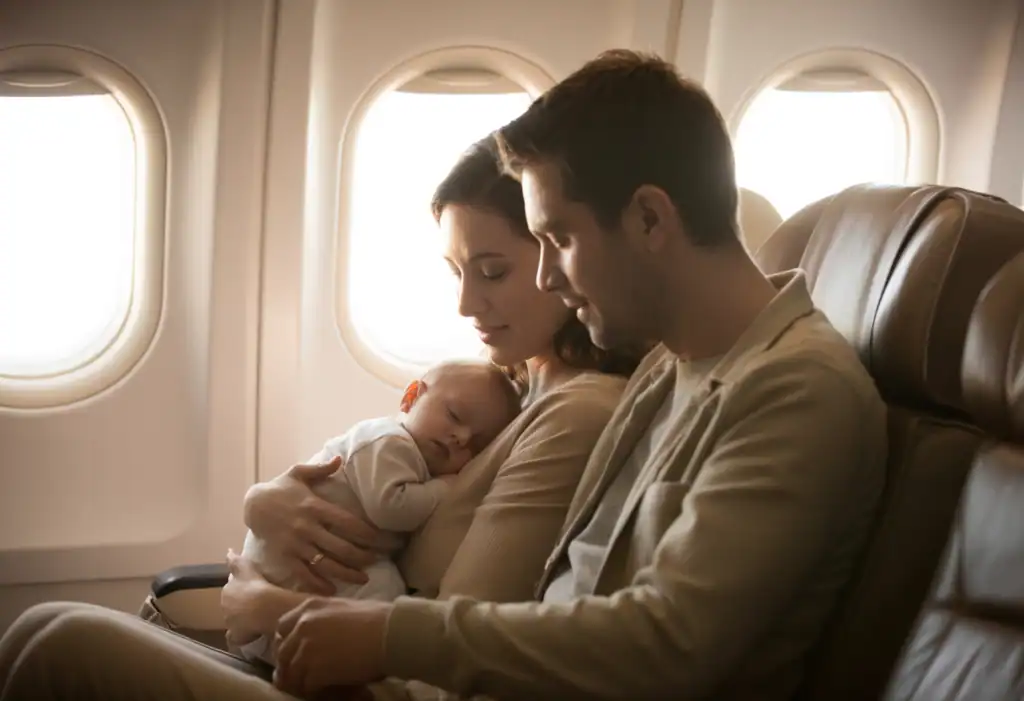
Boarding with a baby
Families with children under 2 usually board early.
- Board early if you need time to set up
- Board later if your baby is happier moving around
At the gate:
- Let baby move and burn energy
- Change their diaper right before boarding
- Prep bottles or start a feed during final boarding call
Takeoff and landing
Most babies struggle with ear pressure.
- Feed during ascent and descent: nursing, bottle, or pacifier
- Start during taxi, not in the air
- If they refuse? Crying helps their ears pop too
Surviving the flight
Short flights (under 3 hours):
Feed, change, soothe, repeat. Young babies mostly want you, not toys.
Long flights (3+ hours):
Think in 45-minute blocks: feed → nap → play → repeat.
- Walk the aisle when safe
- Change diapers every 2–3 hours proactively
- Rotate small toys every 15–20 minutes
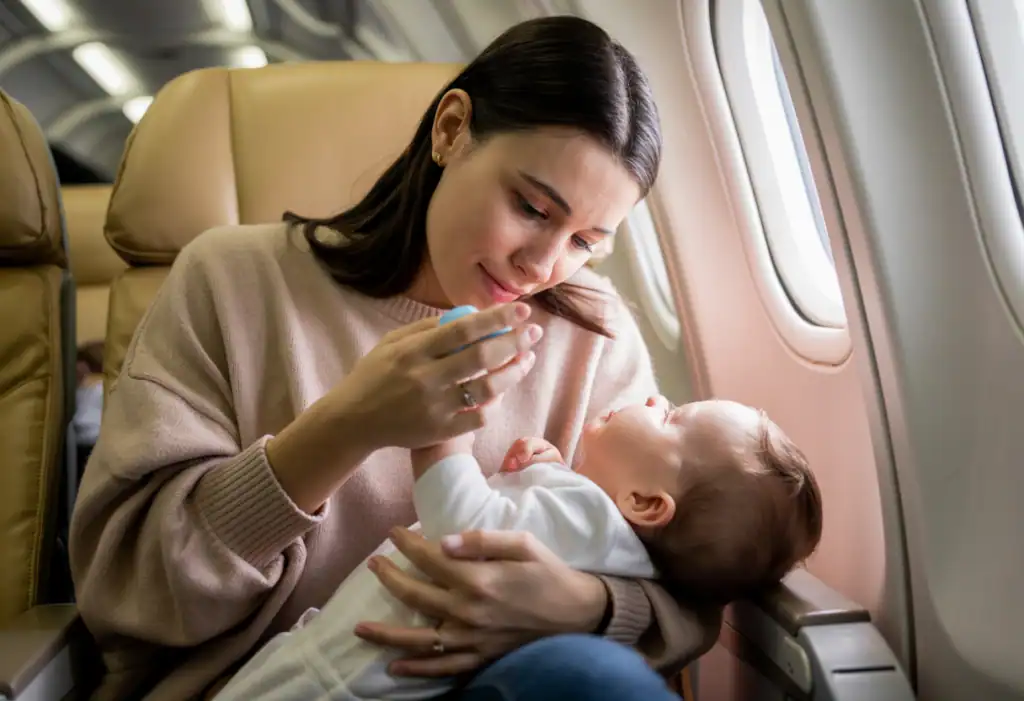
What if my baby cries the whole time?
It happens. Do what you can: feed, bounce, walk, soothe—but accept you can’t fix everything. Most passengers are more understanding than you expect.
What worked for us: Walking the aisle, baby carrier bouncing, white noise, feeding, staying calm.
What didn’t: stressing about strangers. Your baby is allowed to exist in public.
At your destination
Arrive in daylight if possible. Set up the sleep space first. Babyproof the basics.
Sleeping tips
The first night is almost always rough. Your baby is adjusting to new sounds, smells, and lighting.
- Bring familiar sleep cues: sound machine, sleep sack, pacifier, lovey
- Stick to your normal bedtime routine
- Make whatever sleep setup works—even if it’s the crib in the bathroom
Outings and activities
Plan for half of what you’d normally do. Build in downtime. Expect meltdowns and have an exit plan. Stroller naps will save you.
When things go wrong…
- If baby gets sick, know where urgent care is
- If there’s a blowout, laugh and move on
- If the schedule collapses, embrace survival mode
- If dinner goes badly, pack up and go
After your first trip
Expect a little sleep regression and extra clinginess. Give yourself a couple of days to recover.
The first trip is the scariest because of the anticipation, not the reality. After that, you learn your baby’s travel personality, and each trip gets easier.
“Isn’t it easier to wait when they’re older?”
Travelling with a baby is more work than staying home.
BUT you’ll remember. Travel reminds you that parenthood doesn’t cancel the things you love.
Babies are actually more portable now than when they’re running around at age two. And once you get that first flight out of the way, everything after feels easier.
We’re just here to say: If you want to travel, don’t let having a baby stop you. It’s doable, it’s survivable, and it might even be enjoyable.
It’s never easy, but it’s always worth it
You don’t need to be perfect or have a perfectly behaved baby. You don’t need the most expensive gear or the most detailed itinerary.
You just need to decide that you’re going to try.
Safe travels. You’ve got this.
Frequently Asked Questions
What do I need to travel with a baby for the first time?
Focus on the essentials: feeding supplies, plenty of diapers and wipes, familiar sleep items and comfort gear like a carrier or pacifier. Pack a full change of clothes for both you and baby in every bag. Anything extra can be bought at your destination.
Can you take a baby on a plane at 2 months?
Yes. Most airlines allow infants to fly, and many pediatricians are comfortable with travel after the 2-month vaccines. The 2 to 6 month stage is actually one of the easiest times to fly because babies sleep often and are not yet mobile.
How do you pack for a baby’s first trip?
Pack light but smart. Bring double the diapers you think you’ll need, key feeding items, your baby’s usual sleep cues and a few small toys. Skip the huge wardrobe. Three to four outfits and backups in each bag are enough.
What is the best age to travel with a baby?
Most parents find 2 to 6 months the easiest. Babies are sleepy, portable and not yet crawling. The tougher window is 8 to 14 months when mobility and separation anxiety peak. Ultimately, the best age is whenever you feel ready.
Do babies need ID to fly domestically?
In the United States, lap infants under 2 usually do not need ID, but bringing a birth certificate is still a good idea. For international travel, every baby needs a passport regardless of age.
