Newborn Essentials: Where to Splurge vs. Save
If you’re staring at a baby registry right now feeling overwhelmed by conflicting advice, marketing pressure, and the sneaking suspicion that you don’t actually need a $40 muslin swaddle, you’re right to be skeptical.
Here’s where to invest your money and where you can save without compromise.
We’ll also share the three-filter system you can use and the lifestyle considerations that matter when you’re building your newborn essentials list.
How we decide what makes our baby essentials list
You can filter your baby purchases through three questions:
1. Is it safety-critical?
These are non-negotiables where quality directly affects your baby’s wellbeing… we’re talking sleep gear, car seats, anything that holds or transports your child.
You don’t cheap out here, but you also don’t need to buy the luxury version when mid-tier meets the same safety standards.
2. Is it a daily workhorse?
Items used multiple times a day for months earn their cost.
A $200 bassinet used for six months breaks down to about $1.10 per day.
A $150 baby carrier you use for two years? Roughly $0.20 per day. These are investments in your sanity and your back.
3. Is it short-term or occasional?
Newborn clothes worn for four weeks, a bath thermometer you’ll glance at twice, a wipe warmer that sounds nice but adds zero actual value. These go in the “save or skip” column.
A $60 wipe warmer used for three months is $0.67 per day, and for what? Room-temperature wipes work just fine.
Some quality indicators we look for:
When we source products, we know which certifications matter (CPSC safety standards, GREENGUARD for low emissions) versus which ones are just marketing.
Here’s more on it on our blog on how to spot baby products on Amazon.
We also sometimes think about resale value.
If you can sell it secondhand for 50-60% of what you paid, that’s usually a sign it was built to last.
Where to Splurge (And Why)
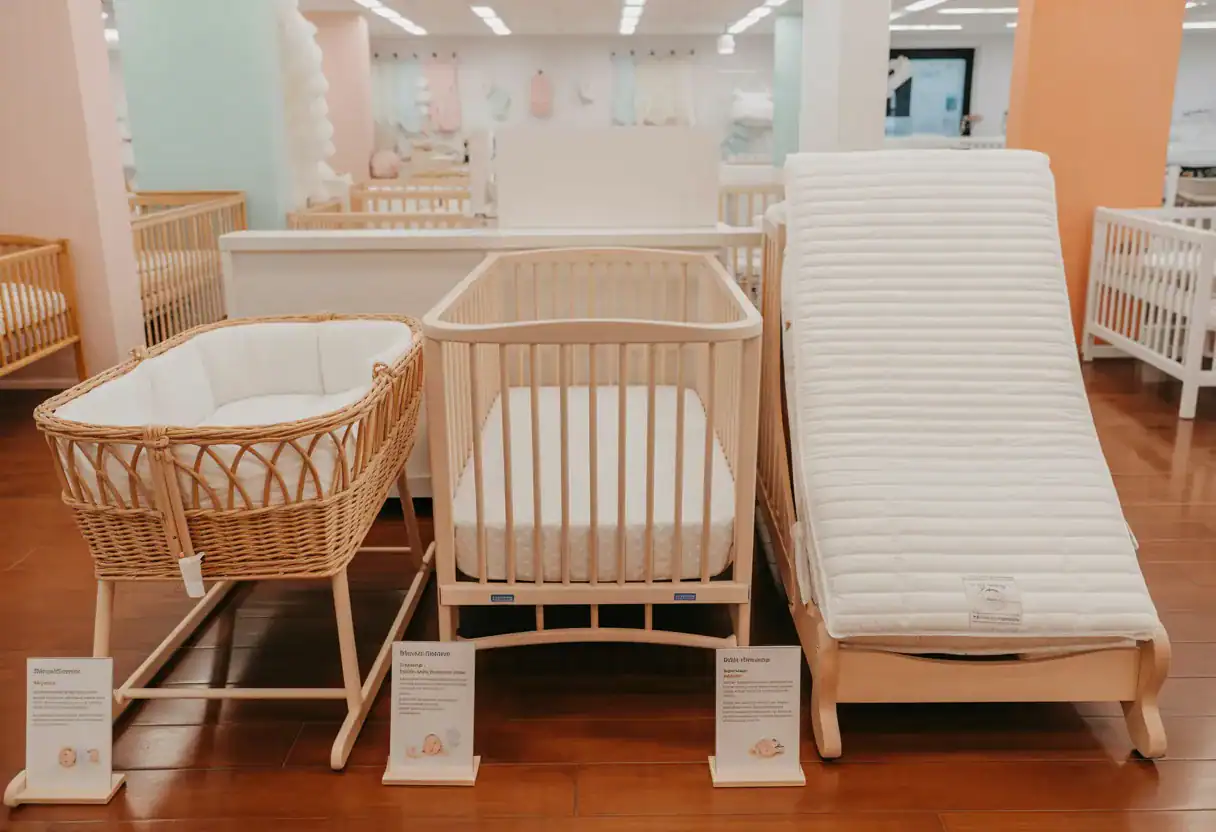
1. Sleep Gear: Bassinet, Crib, and Mattress
Splurge: $200-400 for bassinet; $150-300 for crib mattress
Your baby will spend 14-17 hours a day sleeping in the early weeks. This is where safety and quality matter most.
Cheap crib mattresses either feel flimsy or lack proper breathability.
They won’t necessarily sag before your baby outgrows them, but the difference in firmness and airflow is noticeable. And those details matter when safe sleep is the goal.
What’s worth paying for:
- A firm, breathable crib mattress (look for certifications, not just marketing claims)
- A sturdy bassinet with mesh sides for visibility and airflow
- Waterproof, easy-to-clean covers (because blowouts are real)
Where NOT to splurge: Designer cribs that cost $800 but meet the same CPSC safety standards as a $200 basic model. Your baby doesn’t care if the crib is Instagram-worthy.
If you travel often… invest in a quality pack-and-play that doubles as a bassinet and portable crib. We’ve used ours in 15 countries, and it’s still going strong for baby three.
2. Car Seat
Splurge: $200-350 for infant car seat
This is the ultimate non-negotiable.
You literally can’t leave the hospital without one, and you’ll use it multiple times a day for at least a year.
The small details make a huge difference:
- How easy the harness is to adjust
- Whether the base clicks in securely without a wrestling match
- How the seat actually performs in real life (not just crash tests).
- High safety ratings
- Ease of installation.
- A quality harness system that doesn’t twist or loosen randomly matters.
Again, expensive doesn’t always mean safer. A $400 luxury car seat isn’t necessarily better than a $250 Chicco or Graco that scores just as high on safety tests.
Save option: Skip the travel system (car seat + matching stroller combo).
Buy the car seat you actually want and a separate stroller that works for your lifestyle. You’ll be happier with both.
3. Baby Carrier
Splurge: $100-180 for structured carrier
If you think you’ll just hold your baby or use the stroller for everything, you’re in for a surprise.
Carriers are lifesavers for naps, fussy evenings, airport sprints, and getting literally anything done around the house.
Some cheap carriers feel fine for the first 20 minutes. By week two, you’ll have back pain, your baby will be slouched in a position that’s not great for their hips, and you’ll be online shopping for a better one at 2am.
What’s worth it:
- Ergonomic design that’s hip-healthy for baby and doesn’t destroy your back
- Adjustable straps so multiple caregivers can use it without readjusting for 10 minutes
- Durable, breathable fabric (especially if you live somewhere warm)
- Proper neck support for newborns
Our go-tos: Ergobaby Omni 360 and Lillebaby.
Save alternative: If you prefer wraps, a quality ring sling runs $50-70 and works beautifully for the newborn stage. Just know there’s a learning curve.
4. Feeding Essentials (If Bottle Feeding)
Here’s a quick guide to choosing your baby bottles if you’re still unsure.
You’ll use bottles 4-6 times a day.
If they cause gas, leak, or are a pain to clean, you’ll be miserable.
Dr. Brown’s and Comotomo are known to reduce fussiness and spit-up.
Are they more expensive? Yes. Are they worth it when your baby isn’t screaming for an hour after every feed? Also yes.
What can matter, depending on your baby
- Anti-colic design
- A formula pitcher for batch prep ($40 and a massive time-saver at 3am)
- A quality bottle brush and drying rack
You don’t need 20 bottles. Start with 4-6 and see how it goes.
If breastfeeding:
- Splurge on a quality pump if you’re returning to work and a supportive nursing pillow (your back will thank you)
- Save on fancy nursing covers and excessive milk storage bags initially.. buy as you go
5. Diaper Bag
Splurge: $80-150 for functional, durable bag
You’ll use this daily for 2-3 years.
A poorly designed diaper bag is a special kind of frustration when you’re digging for wipes while your baby is mid-blowout in a public restroom.
What’s worth it:
- Multiple compartments with easy access (insulated bottle pockets, external wipe pocket)
- Wipeable, water-resistant material that doesn’t stain or smell after six months
- Comfortable, adjustable straps (you’ll be carrying this thing for hours at airports)
Skip Hop and Petunia Pickle Bottom can hold up beautifully.
That said, we’re on opposite ends of the spectrum in our household. I prioritize high-quality, functional bags with great organization. My wife just wants it lightweight and waterproof (we live in Vancouver, so rain is a given).
Save option: A quality backpack-style diaper bag in the $60-80 range.
Where to Save
6. Newborn Clothes
Save: $30-50 total for first month
Newborns outgrow everything in 4-8 weeks. Sometimes faster.
What actually gets worn:
- 6-8 onesies and sleepers (that’s genuinely all you need at first)
- Zipper closures over snaps (trust us on this during 3am diaper changes)
Where to buy: Target, Carter’s, Old Navy, or hand-me-downs from friends
Skip entirely:
- More than 2 pairs of shoes (they don’t walk, and tiny socks are cuter anyway)
- Fancy outfits for newborns (they’ll spit up on them immediately)
- Newborn jeans (seriously, why do these exist?)
7. Swaddles and Sleep Sacks
Save: $20-40 for basics
Focus on material over brand. A $15 bamboo muslin swaddle works just as well as a $40 designer one with a trendy print.
What you need:
- 3-4 breathable swaddles (muslin or bamboo blends are great)
- Or 1-2 Velcro swaddles if your baby is an escape artist
Our go-to: Any bamboo or bamboo-cotton blend muslin. They’re soft, breathable, and get softer with every wash. (We actually have a whole post breaking down swaddle fabrics and why bamboo muslin wins)
Skip: Weighted swaddles (not recommended for newborns) and expensive sleep sacks in newborn sizes they’ll outgrow in weeks
8. Bath Gear
Save: $20-30 total
Newborns need sponge baths for the first few weeks, and after that, a basic infant tub works perfectly fine. They’ll outgrow it in about six months anyway.
What we use:
- Simple infant tub or mesh bath seat: $15-25
- Any soft hooded towel (you don’t need the $30 organic ones)
- Regular baby washcloths
Skip:
- Baby bath thermometers (your elbow works)
- Spa-level bath kits with 47 products
- Wipe warmers (room-temperature wipes are fine, and babies adjust instantly)
9. Changing Table
Save: $0-50 (or skip it entirely)
You’ll change diapers on your bed, the couch, the floor, a blanket in the back of your car, and approximately 50 other surfaces that are not a dedicated changing table.
Budget option: Put a $30-40 changing pad on top of a dresser you already own.
Skip: Dedicated changing tables. They’re big, expensive, and you’ll use them for maybe a year before they become glorified laundry holders.
10. Toys and Entertainment
Save: $0-30 for the first 3 months
Newborns don’t need toys.
They need sleep, food, clean diapers, and to stare at your face.
What entertains a newborn:
- High-contrast black-and-white cards ($10)
- Your face
- A ceiling fan (inexplicably fascinating)
Wait to buy: Play mats, mobiles, and activity gyms until 2-3 months when they’re actually alert enough to care
Skip: Infant entertainment systems, expensive mobiles, and anything marketed as “developmental” for a newborn (they’re developing just fine by existing)
The Bottom Line
This is the framework that’s worked for us through three kids, countless flights, and more diaper blowouts than we care to count.
- Safety first. Don’t compromise on car seats, sleep surfaces, or anything that directly affects your baby’s wellbeing.
- Daily-use items second. If you’ll use it multiple times a day for months, it’s worth investing in quality that won’t break, hurt your back, or make you miserable.
- Everything else is negotiable. Newborn clothes, fancy bath gear, decorative nursery items.
You’re not a bad parent for buying budget basics. You’re a smart one.
Babies need safe sleep, food, clean diapers, and love. They don’t need $2,000 nurseries or designer onesies they’ll outgrow in three weeks.
Start with the splurge list, fill in the save items as you actually need them, and ignore the rest until you know what your baby—and you—genuinely require.
What’s one item you splurged on that was totally worth it—or one you wish you’d skipped? Drop it in the comments. We’re always learning from other parents in the trenches!
