
How to Actually Limit Screen Time for Toddlers (Without Losing Your Mind)
If you’ve tried the “cold turkey” approach and ended up with a screaming toddler and your own meltdown, you’re not alone.
Most advice online treats this like flipping a switch, when reality is messier, more gradual, and requires actual strategy.
Not all kids are the same, neither are households. Parenting styles also vary.
It’s important to know your child and how you want to go about screen time too.
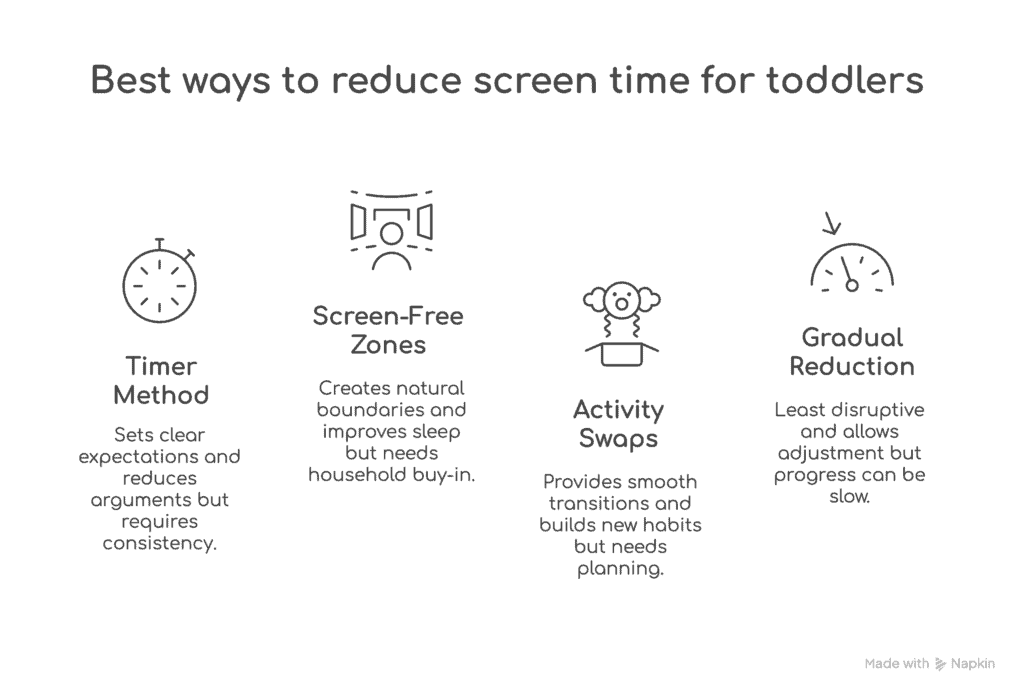
Here are some of the best and sustainable tips on how to limit screen time for toddlers:
1. The timer method

This is great for: Toddlers who respond to routine, parents who like clear boundaries
How it works: Set a visible timer for screen time sessions. When it goes off, screens go away. Start with current usage and reduce by 10-15 minutes weekly.
This works because…
- It sets clear expectations (reduces arguments)
- Has a visual countdown that helps toddlers prepare
- It’s easy to implement with phone timers or kitchen timers
- Works for most device types
The drawbacks:
- Initial resistance when timer goes off
- Requires consistent follow-through from all caregivers
- Doesn’t work for all personalities
And while we’re at it, if you’re looking for specific activities to fill the screen-free time you’re creating, check out our guide to screen-free toys for toddlers!
2. Screen-free zones

This is great for: Families wanting gradual change, homes with clear room divisions
How it works: Designate specific areas (bedrooms, dining room) or times (meals, before bed) as completely screen-free.
This works because…
- Easier to enforce than time limits
- Creates natural boundaries
- Improves sleep when bedrooms are screen-free
- Family meals become actual conversation time
The drawbacks:
- Harder in open floor plans
- Requires household buy-in from adults too
- May push screen time into concentrated bursts
3. Activity swaps

This is great for: Parents who can plan ahead, toddlers who need immediate replacement activities
How it works: Before removing screens, have specific activities ready. Think sensory bins, coloring, outdoor time, or helping with “grown-up” tasks.
This works because…
- Smoothest transition for toddlers
- Builds new habits alongside reducing old ones
- Teaches toddlers what to do instead of just what not to do
- Can be tailored to your child’s interests
Cons:
- Requires advance planning and prep
- More work for parents initially
- Some activities create their own messes
- Energy-intensive for tired parents
4. Gradual reduction

This is great for: Heavy screen users, families wanting minimal drama
How it works: Slowly reduce screen time by 15-30 minutes every few days. Track current usage first, then systematically decrease.
This works because…
- Least disruptive approach
- Allows adjustment time for everyone
- Easy to implement with parental control apps
- Lower chance of major meltdowns
Drawbacks:
- Slow progress can feel frustrating
- Requires tracking and consistency
- Easy to backslide during stressful periods
- May not address underlying screen dependency
Some roadblocks you can run into…
Going cold turkey without replacement activities
Your toddler will melt down, and you’ll cave. Have a plan for what comes next.
Inconsistent rules between caregivers
If mom says no screens but grandma gives in, you’re fighting an uphill battle (been there, done that!)
Using screens as the only coping mechanism
If tablets are your go-to for grocery stores, restaurants, and car rides, you’ll need alternative strategies first.

Expecting immediate behavior changes
Even successful screen time reduction takes 2-3 weeks to feel “normal” for most toddlers.
Perfectionist approaches
Some days you’ll use more screens. Sick days, travel, and rough patches happen. That’s not failure.
Remember: you’re not failing if you use screens more some days. You’re succeeding if you’re being intentional about it.
FAQs
How long does it take for screen time limits to feel normal?
Most families see adjustment within 2-3 weeks, but the first few days are typically the hardest. Consistency during this adjustment period makes the biggest difference.
Should I limit my own screen time too?
Toddlers copy what they see. If you want them to play independently instead of asking for screens, they need to see you doing non-screen activities too.
What if my toddler is addicted to a specific show or app?
Gradual transition works better than cold turkey. Try introducing new shows/apps first, then slowly rotating out the problematic one. Sometimes the issue is routine, not the actual content.
Do educational screens count toward daily limits?
The American Academy of Pediatrics recommends treating all screen time equally for toddlers under 3. Their brains don’t distinguish between “educational” and entertainment content yet.
How do I handle screen time when traveling?
Build extra flexibility into your rules for travel days, long car rides, or flights. Many families double their usual limits during travel and return to normal routines once home.
What about screens during illness?
Sick days often need different rules. Extra comfort and distraction are normal when kids don’t feel well. Just plan to gradually return to regular limits as they recover.
